
The Shroud of Turin proves the Resurrection
Pollen found on the shroud
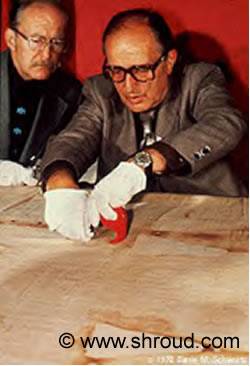 Botanists have discovered pollen and spores on the linen of the Shroud, and these have been extensively researched in many laboratories.
Dr Max Frei was a botanist and noted Swiss criminologist. He took samples from the surface of the Shroud in 1973 and 1978, as a member of the STURP team. Dr Frei identified pollen and spores of 58 different plants, many that originate only in and around Jerusalem and areas of the Middle East, including the ancient cities of Constantinople and Edessa.
Subsequent researchers included:
- Dr. Avinoam Danin, a Botany Professor at the Hebrew University of Jerusalem.
- Dr. Uri Baruch, a pollen specialist at the Israel Antiquities Authority.
- Oswald Sheuermann, a German physics teacher.
- Dr. Alan Whanger, a Professor at Duke University, USA.
Research revealed that of the 28 plants, 20 are known to grow in Jerusalem itself and 8 others grow in the vicinity in the Judean desert or the Dead Sea area. Though some of these plants may be found in Europe, 14 of the 28 plants only grow in the Middle East and never in Europe. Of the 28 plants, 27 bloom in the Spring, corresponding with the Jewish Passover.
Pollen of the tumbleweed Gundelia Tournefortii
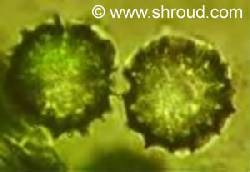 Professor Avinoam Danin of the Hebrew University of Jerusalem identified a high density on the Shroud of pollen of the tumbleweed Gundelia tournefortii
Pollen of Zygophyllum dumosum
Professor Avinoam Danin also identified a high density of pollen on the Shroud of Zygophyllum dumosum on the Shroud, as well as an image of the actual plant. This plant grows only in Israel, Jordan, and the Sinai.
Professor Avinoam Danin’s analysis
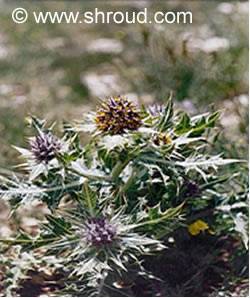 Professor Danin said that the two species, Gundelia tournefortii and Zygophyllum dumosum, co-exist in a limited area only. He also said, “This combination of flowers can be found in only one region of the world. The evidence clearly points to a floral grouping from the area surrounding Jerusalem. In the light of our findings, it is highly probable that the Shroud did in fact come from this part [the area around Jerusalem] of the world.”